
Pacific Link: Canada Reduces Dependence on U.S. Oil Markets
Pacific Link: Canada Reduces Dependence on U.S. Oil Markets
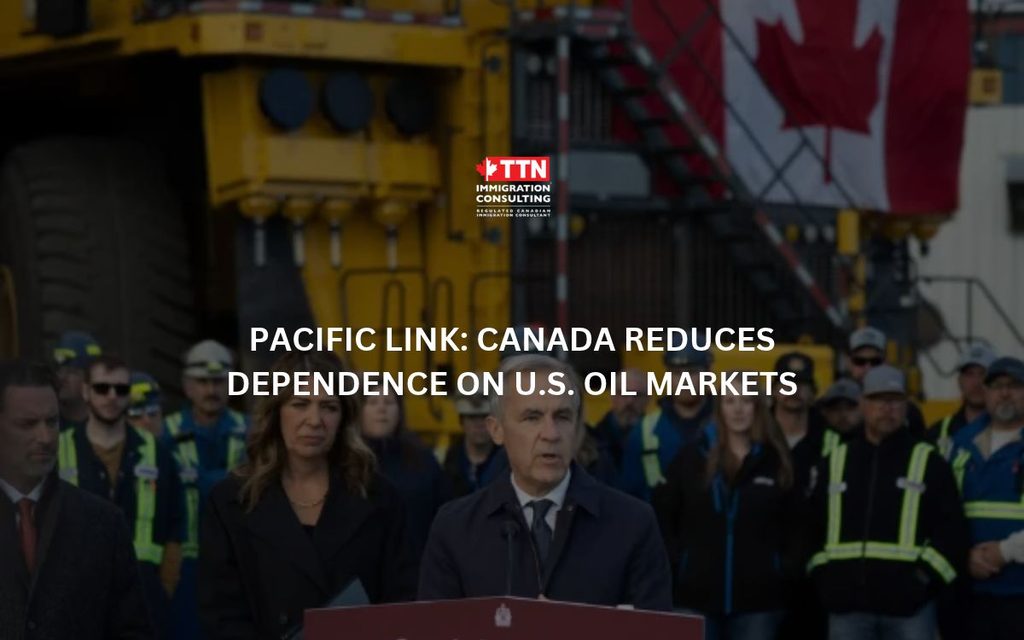
On October 1, 2026, Prime Minister Mark Carney announced that the Government of Canada had officially designated the West Coast Oil Pipeline project—now named Pacific Link—as a "project of national interest" under the Building Canada Act.
Dự án được kỳ vọng mở rộng khả năng xuất khẩu dầu của Alberta sang các thị trường quốc tế, đặc biệt là châu Á, đồng thời tạo thêm việc làm và thúc đẩy đầu tư vào nền kinh tế Canada.
What is the Pacific Link project?
Pacific Link is the new name for the West Coast Oil Pipeline, a proposed interprovincial pipeline project to transport crude oil from Bruderheim, Alberta, to southern British Columbia.
According to the Major Projects Office (MPO), the pipeline has a projected capacity of up to 1 million barrels of crude oil per day. The project also includes a receiving facility and a new deep-water terminal near Delta, British Columbia, to enable the loading of oil onto vessels for export to international markets.
Why is Canada promoting Pacific Link?
Currently, approximately 90% of Alberta's oil is exported to the United States. According to the Canadian government, Pacific Link will help reduce this reliance by opening up access to emerging markets in Asia.
With an additional capacity of approximately 1 million barrels per day, Canada can reach more international customers and diversify its energy export markets. The Canadian government also believes that expanding access to global markets will enhance competitiveness and foster greater long-term demand stability for Canadian oil.
This is also part of the Canadian government's broader goal of doubling exports to markets outside the United States over the next decade and attracting more investment into the economy.
Pacific Link has been recognized as a "project of national interest."
The inclusion of Pacific Link in the list of projects of national interest was carried out in accordance with the Building Canada Act.
Under the new process, the Major Projects Office will coordinate with the Canada Energy Regulator (CER) to conduct the review and consultation process over the coming year.
The issues under consideration include:
- Project ownership structure;
- Economic benefits and benefits for communities;
- Rights and interests of Indigenous Peoples;
- Environmental protection measures;
- Recruitment and employment of local labor;
- Project contracts and monitoring mechanisms.
MPO aims to fulfill the project's conditions by September 1, 2027. Subsequently, the project can proceed to the next stages of construction implementation.
A notable point is that recognizing the project from the outset provides developers with greater clarity when carrying out tasks such as community consultation, route determination, ecological surveys, cost estimation, procurement preparation, and workforce planning.
The project is expected to create 140,000 jobs.
According to the Canadian government, Pacific Link could create approximately 140,000 jobs across Canada during the project's construction and development phases.
The work may span various sectors, ranging from engineering, pipe installation, and welding to roles within the supply chain and supporting infrastructure construction.
The Canadian government also stated that the project could generate:
- Over CAD 20 billion in annual GDP;
- Over C$100 billion in government revenue by 2060.
The Canadian government has earmarked this revenue stream to support investments in infrastructure, housing, and social programs.
Canada and Alberta will jointly own the project.
According to an announcement by the Government of Canada, Canada and Alberta will share ownership of Pacific Link on an equal basis.
In addition, Indigenous communities will be offered the opportunity to hold a minimum 10% equity stake in the project. This equity participation will be supported through loan guarantee programs for Indigenous Peoples provided by Canada and Alberta.
Pembina Pipeline Corporation is participating as a private-sector investor, while Trans Mountain Corporation will lead the project development process.
The project also comes with environmental requirements.
Pacific Link is not just about pipeline construction.
The Canadian government stated that the project must be accompanied by environmental and marine protection measures, particularly given the increase in maritime shipping activity.
The route is expected to follow a southern corridor to avoid British Columbia's North Coast region and sensitive ecosystems, including the Great Bear Sea.
Canada is also promoting investments in low-emission technologies—including the Pathways Project—aimed at reducing emissions from oil extraction operations in Alberta.
What does Pacific Link mean for the Canadian economy?
Pacific Link is seen by the Government of Canada as part of a broader strategy to:
- Diversifying Canada's export markets;
- Reduce reliance on a single trading partner;
- Expand access to Asian markets;
- Attract more investment to Canada;
- Create additional jobs in the construction, energy, and related sectors;
- Increase government revenue;
- Developing export-oriented infrastructure.
However, recognition as a project of national interest does not mean Pacific Link has completed the entire approval and construction process. Moving forward, the project must still undergo review and consultation, and address conditions regarding the environment, Indigenous Peoples, the route, ownership, and other issues.
Pacific Link and job opportunities in Canada
With a projected capacity of up to 1 million barrels per day and an estimated 140,000 jobs according to the Canadian government, Pacific Link could generate workforce demand across various sectors, including engineering, construction, welding, pipefitting, operations, logistics, and technical trades.
This is one of the notable factors for the Canadian labor market in the coming years. However, the employment figures are estimates by the Canadian government and do not imply that all positions will be filled immediately or reserved for foreign workers.
Conclusion
Canada's official designation of Pacific Link as a project of national interest marks a significant step forward in the country's plans to expand energy infrastructure and diversify export markets.
If implemented according to plan, the project will create an additional oil export route from Alberta to the West Coast, expand access to Asian markets, and generate significant demand for labor, construction, and related services during its development.
